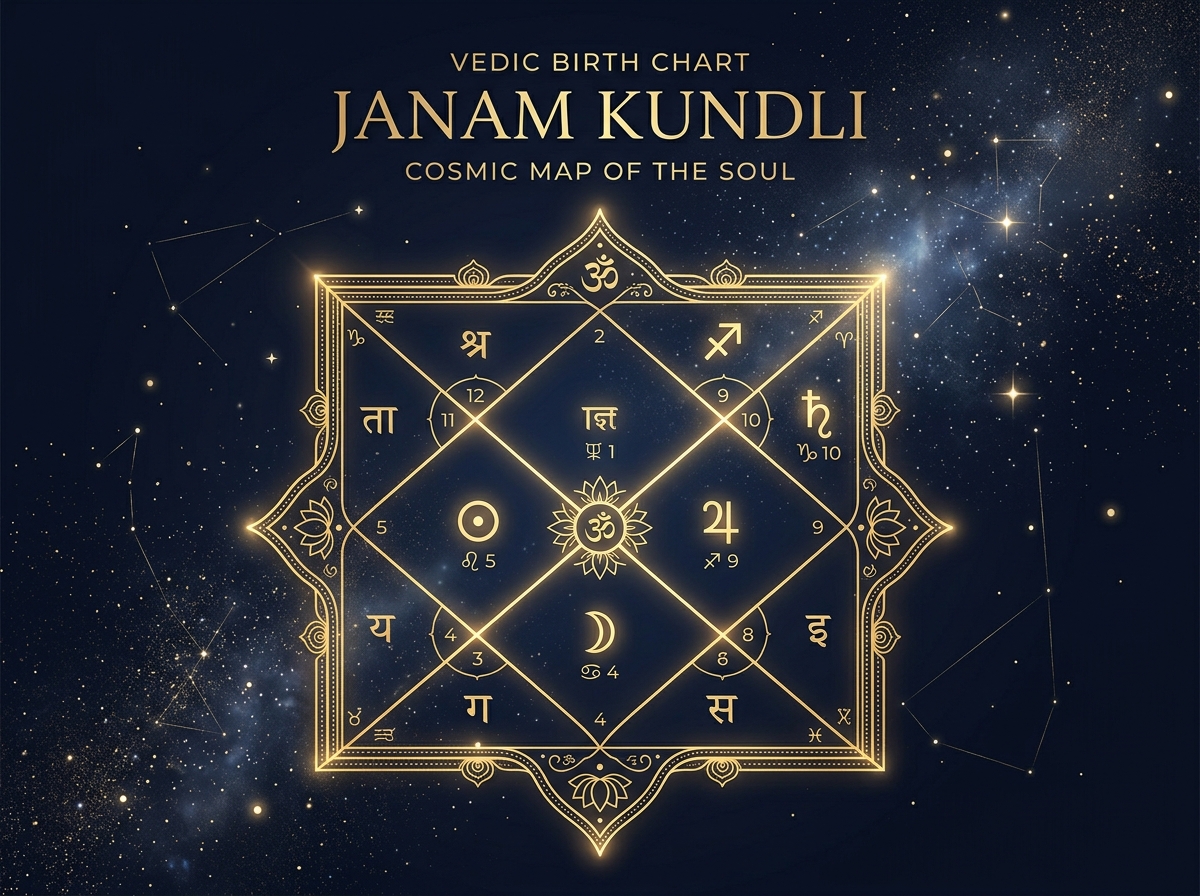
What Exactly Is a Janam Kundli?
In Sanskrit, Kundli refers to a scroll or coiled diagram representing the sky. When a human being takes their first independent breath, the position of the Sun, Moon, and planets against the backdrop of the 27 Nakshatras and 12 Rashis creates a distinct energetic imprint.
Unlike Western astrology which utilizes the solar Tropical zodiac, Vedic astrology (Jyotish) is rooted in the Sidereal Zodiac. This framework incorporates Ayanamsha (the gradual precession of the equinoxes), ensuring that planetary positions in your chart correspond directly to visible constellations in the sky today.
The Anatomy of a Birth Chart
Every authentic Vedic birth chart is constructed from four fundamental components working in unison:
1. The Lagna (Ascendant / Rising Sign)
The Lagna is the specific zodiac sign ascending on the eastern horizon at your exact minute and coordinates of birth. The Lagna designates the First House (Tanu Bhava) and determines the ruler of your chart, shaping your physical vitality, worldview, and psychological disposition.
2. The Twelve Bhavas (Houses)
The chart is partitioned into 12 Bhavas, each governing distinct dimensions of human experience:
- 1st House (Lagna): Self, physical constitution, vitality, natural inclination.
- 2nd House (Dhana): Accumulated wealth, family lineage, speech, values.
- 4th House (Sukha): Mother, emotional peace, ancestral roots, home.
- 7th House (Kalatra): Marriage, long-term partnerships, public relations.
- 9th House (Bhagya): Dharma, higher wisdom, father, grace, life fortune.
- 10th House (Karma): Profession, leadership, social status, public contributions.
3. The Navagrahas (Nine Celestial Influencers)
The nine celestial forces in Vedic astrology include the luminaries (Surya and Chandra), the personal planets (Mangal, Budh, Shukra), the great teachers (Guru and Shani), and the lunar nodes (Rahu and Ketu).
4. Vimshottari Dasha — The Rhythm of Time
A chart without timing is incomplete. The Vimshottari Dasha system assigns a 120-year cycle governed sequentially by nine planets. Depending on your natal Moon's exact Nakshatra pada, your life unfolds through planetary periods (Mahadashas and Antardashas) that activate specific houses and karmic themes.
Divisional Charts (Vargas): Peering Beneath the Surface
A master astrologer never evaluates the primary chart (D1 Rashi) in isolation. Vedic astrology uses sub-harmonic divisional charts (Vargas) to dissect specific spheres of life:
- Navamsha (D9): The chart of marital compatibility, spiritual maturity, and the true strength of planets in the second half of life.
- Dashamsha (D10): The micro-chart analyzing career trajectory, leadership capabilities, and occupational success.
- Saptamsha (D7): Dedicated to progeny, creative legacy, and family expansion.
- Shashtiamsha (D60): The highest division (1/60th of a sign) explaining deep past-life karmic momentum.
“The birth chart does not dictate what must happen; it reveals the predispositions of consciousness and the karmic currents that you have arrived to master.”
How Astronik Calculates Your Kundli
Astronik uses the globally respected Swiss Ephemeris (SE) algorithms calibrated to the Lahiri (Chitrapaksha) Ayanamsha. We compute planetary longitudes down to the arcsecond, accounting for topocentric latitude-longitude, atmospheric refraction, and true lunar nodes.